Before we begin, Remember: Harappan Civilization is also known as Indus Valley Civilization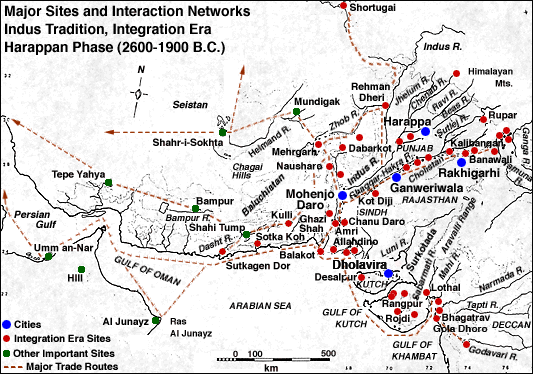
The Discoverers of Indus Valley Civilization:
- Alexander Cunningham – He was the first Director-General of ASI. He Began excavations around mid nineteenth century.
- John Marshall – He was the DG of ASI in 1927 and first professional Archaeologist of India.But he excated horizontlly and all finds were grouped together even when they were found at different stratigraphic layers. This caused loss of very valuable information regarding.
- R.E.M. Wheeler – He followed the stratigraphy of excavations rather than just excavating horizontally.
Basic features of Indus Valley Civilization:
- The Indus Valley civilization is the first known Urban Culture in India.
- Majority of the sites developed on the banks of river Indus, Ghaggar and its tributaries.
- This civilisation is credited for building cities complete with : town planning, sanitation, drainage system and broad well-laid roads.
- They also built double storied houses of burnt-bricks complete with bathroom , kitchen, and a well.
- Their Walled cities had important buildings such as, the Great Bath, Granaries and the Assembly Halls.
- Thier Agriculture was considered major occupation for rural areas.While the City residents were involved in internal & external trade which led to developed contacts with other civilizations ( e.g. Mesopotamia).
- Harappans were excellent potters as is evident by their artifacts.
- Harappans also had technical knowledge of metals & process of alloying (e.g. bronze sculpture of dancing girl found in Mohenjodaro).
- Also, Shell, ivory, bone and faience were used as material for different crafts.
- Here, Lothal deserves special mention as the site for dockyard. It is situated in Ahmedabad, Gujarat.
- Lothal was a well planned walled city which was an important centre of sea trade with the western world.
- Other important cites were- Dhaulavira (Guj.) & Kalibangam (Rajasthan).
- Harappans used to worship plants, animals and the forces of nature.
- They also worshipped male god resembling Lord Shiva of later times and a mother goddess.
- They also probably believed in life after death and also in charms and spells.
- Their Seals were engraved with animal figures (e.g. humped bull, elephant and rhinoceros). This suggests that these animals were considered sacred.
- The image of ‘Peepal’ tree is found depicted on many seals.
- Harappan script is yet to be deciphered. Hence, our knowledge of Harappan civilization is solely based on archaeological evidence alone.
- Harappans were the first people to cultivate cotton. They knew the art of spinning & weaving.
Important sites of Indus Valley Civilisations
Firstly, lets look at major sites:
- Harappa was an urban center. It is in Punjab Province of Pakistan, located on an old river-bed of River Ravi.
- Mohenjo Daro is located in Sindh province of Pakistan, which is next to the river Indus.
- Dholavira is situated on ‘Khadir Beyt’, which is an island in Rann of Kutch,Gujarat, India.
- Lothal is located near the Sabarmati river and Arabian sea, in the Gulf of Khambat, Gujarat, India.
- Rakhigarhi was discovered in Haryana, India only in 1990.
- Ganeriwala is located in Punjab province of Pakistan and is very near to the Indian border.
Minor Sites are also being excavated with reference to Indus Valley Civilization
- ‘Gola Dhoro’ or Bagasara is a site located in Gujarat, India.
- Daimabad is located in Maharashtra near Mumbai.
- Chanhudaro is located just 80 miles south of Mohenjo Daro in Sindh, Pakistan. It has been established a manufacturing center.
- Sutkagen Dor is located in Baluchistan. It is also the westernmost site of Harappan civilization
Vedic Civilization
The Vedic Civilization was the culture and traditions of the society prevalent during the Vedic age ( 1500- 600 BCE). In various examinations which have a section of general studies, often ask a question or two about the Vedic civilization. This chapter of the history study material & notes is meant to cover the essential and exam-worthy details of the ancient Vedic period.
It should be noted here that after the decline of Indus Valley civilization by 1500 BCE, the next wave of civilization began to take shape in form of Aryan occupation of Indo-Gangetic plain.
The Aryans:
- Typically, the age of Aryans is known as the Vedic age because the four major Vedas were created in this time.
- The word Aryan is derived from the Sanskrit word “arya” which means noble, not ordinary.
- They arrived from russian steppes, as is believed and agreed to by majority historians.
- But various scholars voice different opinion about thier origin. Bal Gangadhar Tilak argued that Aryans came from the Arctic region following their astronomical calculations.
- It is generally agreed that they spoke Indo-Aryan Language, Sanskrit.
- They were semi-nomadic, pastoral people, who led a rural life as compared to the urban Harappans.
Vedic Literature:
- The term Veda means “superior knowledge” in Sanskrit.
- Four major Vedas constitute the vedic literature. They are – Rig Veda, Yajur Veda, Sam Veda, and Atharva Veda.
- Rig Veda – Earliest veda. Has 1028 hymns in praise Gods.
- Yajur Veda – Has details of rules to be followed during sacrifices.
- Sam Veda – Has a collection of songs. The origins of Indian music are traced to it.
- Atharva Veda – has a collection of spells and charms.
- Besides these Vedas, there were Brahmanas, Upnishads, Aryankas, and epics- Ramayana and Mahabharata.
- Brahmanas – Prose about vedic hymns, rituals and philosophies.
- Aryankas – Deal with mysticism, rites and rituals.
- Upnishads – Philosophical texts dealing with soul, mysteries of nature.
- Ramayana was authored by Valmiki.
- Mahabharata was written by Ved Vyasa.
Classification of Vedic Period:
The period of Vedic Civilization(1500-500 BCE) is divided into two broad parts –
- Early Vedic Period (1500-1000 BC), also known as Rig Vedic Period.
- Later Vedic Period (1000- 600 BC).
We will study the following features of the Vedic Civilization under these two periods
Political Organisation in Vedic Age:
In Early Vedic Age:
- ‘Kula‘ was the basic unit of political organization.
- Multiple families together of kinship formed a ‘grama‘.
- Leader of ‘grama’ was ‘Gramani‘.
- Group of villages were called ‘visu’, headed by ‘vishayapati‘.
- The highest political and administrative unit was ‘jana‘ or tribe.
- There were several such tribal kingdoms – Bharatas, Matsyas, Yadus and Purus.
- The head of kingdom was ‘Rajan‘ or king.
- The Rig Vedic polity was hereditary monarchy normally.
- There were two bodies- Sabha(council of elders) and Samiti(general assembly of people).
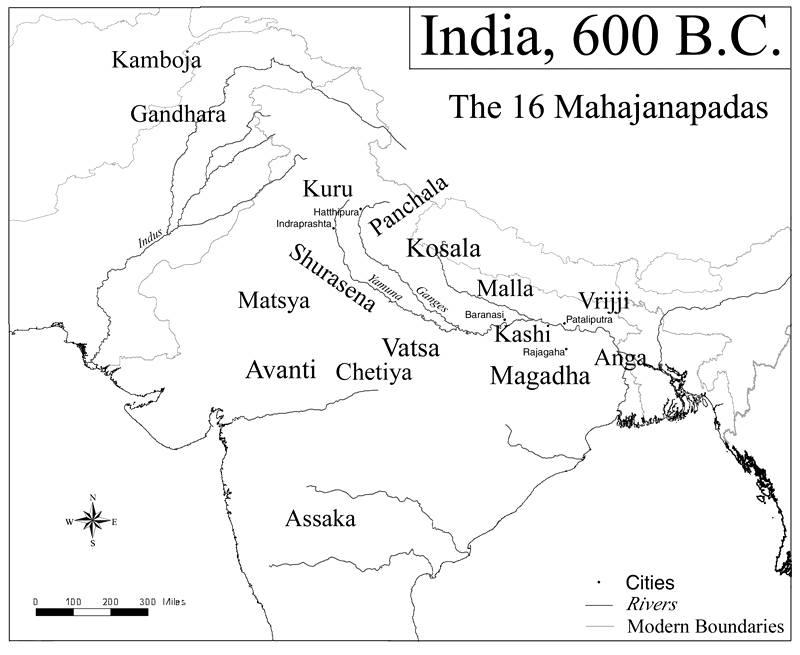
In Later Vedic Age:
- Larger kingdoms by amalgamation formed ‘Mahajanapadas or rashtras‘.
- Therefore, the power of king increased and he performed various rituals and sacrifices to make his position strong like Rajasuya (consecration ceremony), Asvamedha (horse sacrifice) and Vajpeya (chariot race).
- The kings assumed titles of Rajavisvajanan, Ahilabhuvanapathi(lord of all earth), Ekrat and Samrat (sole ruler).
- But, importance of the Samiti and the Sabha diminished.
Society in Vedic Civilization:
In Early Vedic Age:
- The Rig Vedic society was basically patriarchal.
- The basic unit of society was ‘graham’ or family, its head was called as ‘grahapathi’.
- Monogamy was practiced while polygamy among royal and noble families was observed.
- Women had equal opportunities as men for their spiritual and intellectual development. Apala, Viswavara, Ghosa and Lopamudra were women poets.
- Women could attend the popular assemblies.
- No child marriage, sati practice.
- Social divisions were not rigid.
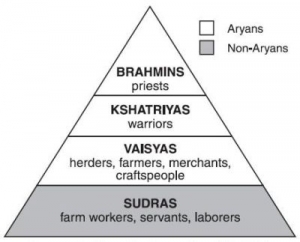
In Later Vedic Age:
- The Varna system became prevalent- four divisions of society :Brahmins, Kshatriyas, Vaisyas and Sudras.
- A Brahmin and Kshatriyas occupied a higher position than others.
- Various sub-castes on the basis of occupation emerged.
- Women were considered inferior and subordinate to men now and also lost their political rights of attending assemblies.
- Child marriages became common.
Economic Conditions in Vedic Civilization:
In Early Vedic Age:
- The Rig Vedic Aryans were pastoral, cattle rearing people.
- After they permanently settled in North India they began agriculture.
- Carpenters produced chariots and ploughs.
- A variety of articles with copper, bronze and iron were made by workers.
- Spinning was an important occupation – cotton and woolen fabrics.
- Goldsmiths made ornaments.
- The potters made different kinds of vessels for domestic use.
- Trade was conducted by barter system in begining but later shifted to use of gold coins called ‘nishka‘ for large transactions.
- Rivers acted as means of transport.
In Later Vedic Age:
- More land was put under cultivation by clearing forests. Knowledge of manure saw development.
- Hence, Agriculture became the chief occupation of people growing barley, rice and wheat.
- Industrial activity became specialized with metal work, leather work, carpentry and pottery advancement.
- Internal trade as well as foreign trade also became extensive (they traded with Babylon through sea).
- Hereditary merchants (vaniya) came into existence as a different class.
- Vaisyas indulged in trade and commerce organized themselves into guilds known as ‘ganas‘.
- Coins: Beesides ‘nishka’, ‘satamana’– gold coins and ‘krishnala‘ – silver coins were also used as a media of exchange.
Religion in Vedic Period:
In Early Vedic Age:
- Rig Vedic Aryans worshiped natural forces like earth, fire, wind, rain and thunder by personifying them into many gods.
- Some important Rig Vedic gods – Prithvi (Earth), Agni (Fire), Vayu (Wind), Varuna (Rain) and Indra (Thunder). And ‘Indra’ was most popular. Next came ‘Agni’ – an intermediary between the gods and the people.
- ‘Varuna’ – the upholder of natural order.
- Female Gods – ‘Aditi’ and ‘Ushas’.
- No temples and no idol worship.
- Prayers were offered to gods for rewards.
In Later Vedic Age:
- Indra and Agni lost their importance.
- Prajapathi (the creator), Vishnu (the protector) and Rudra (the destroyer) became.
- Sacrifices and the rituals became more elaborate.
- But the importance of prayers declined.
- Priesthood became a hereditary profession. They dictated the rules for these rituals and sacrifices.
- Therefore, by the end of this period there was a strong reaction against this priestly domination (also against elaborate sacrifices and rituals). This led to the rise of Buddhism and Jainism.
Solve these 50 mcq after Reading the content for early and fast revise of each small detail..
Many questions are asked based on these sites in various exams like SSC, IBPS, CDS, NDA, UPSC civil services and state public service commission exams. It is advised to revise these details multiple times to answer the questions asked in these exams. Many times candidates get confused about minor details and tend to loose marks over such simple and basic topic even after reading and knowing about it
